Frontier AI has become remarkably democratized. A company or individual can access models that cost billions to develop within minutes and pay only for the inference it consumes. Capabilities that only major research organizations could build a few years ago are now available through an API.
But access and control are not the same thing.
Enterprises usually do not own the model, control the infrastructure on which inference runs, or decide how long a particular model remains available.
That may be perfectly acceptable while AI is helping employees write emails or summarize documents. It becomes a different question when a significant part of business operations depends on AI.
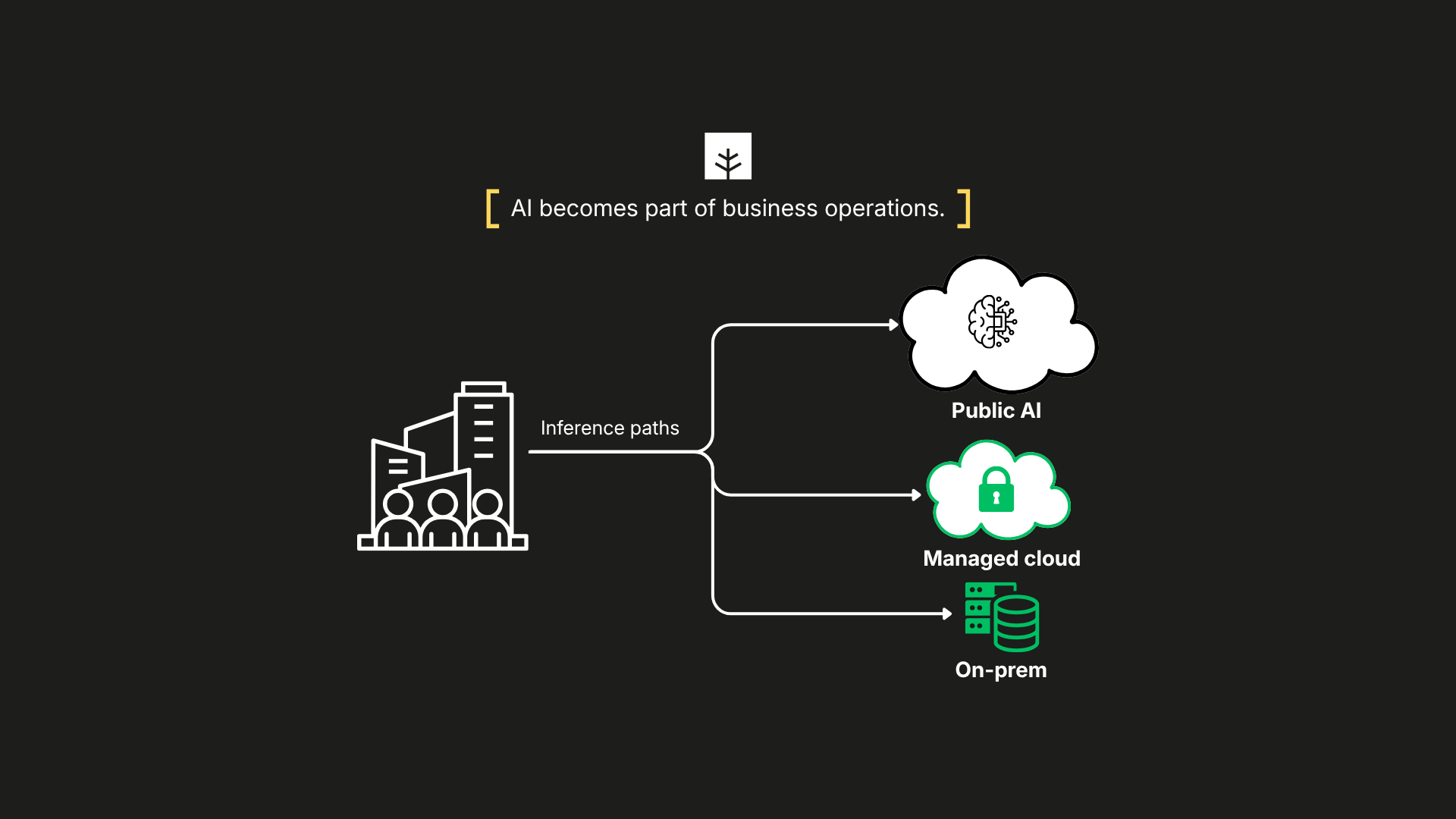
At that point, inference becomes production infrastructure. And production infrastructure needs capacity, high availability and disaster recovery. Recent restrictions on models for political, security and commercial reasons make this more than a theoretical concern.
If our preferred inference source disappears, can the business continue operating?
Three dimensions of inference sovereignty
1) Capacity sovereignty
At one extreme, the enterprise simply consumes a public model API. At the other, inference runs on infrastructure physically controlled by the enterprise.
Between those extremes are private cloud deployments, reserved capacity, multiple cloud regions and multiple inference providers.
This is primarily a question of: availability, infrastructure dependency, data location and economics.
Enterprises probably do not need to own enough compute for every possible peak. A more realistic model may be to control some assured base capacity and buy additional capacity externally when needed.
2) Model sovereignty
Capacity control does not necessarily mean model control.
An enterprise may run a closed model inside its own environment while the model itself still belongs to its provider. With open-weight models, it may gain substantially more control over where and how the model is operated.
This creates an important distinction:
Operational sovereignty is not the same as model sovereignty.
Running inference in your own datacenter protects against some infrastructure and connectivity risks. It does not automatically remove dependency on the model owner.
3) Workload portability
This is probably the hardest part. Technically, switching inference endpoints is becoming relatively easy. Switching models without changing application behavior is not.
GPT, Claude, Gemini, Qwen or Mistral may expose similar APIs while reasoning differently, choosing different tools and producing different error patterns.
So an AI disaster-recovery plan cannot simply say:
“If Model A fails, switch to Model B.”
The real question is whether Model B can execute that particular business workload within an acceptable performance and risk envelope.
API portability is not behavioral portability.
The market is already moving
Different parts of the industry are addressing different pieces of the problem.
-
Inference gateways such as OpenRouter, Kong, LiteLLM, Portkey and Cloudflare increasingly provide a common layer across models and providers, with routing, fallback, retries and load balancing. They make technical switching easier, but they cannot make different models behave identically.
-
AWS Bedrock offers frontier and open-weight models through a common platform and can distribute inference capacity across AWS regions. This provides additional serving and capacity options while dependency on the underlying model owner may remain.
-
Microsoft Foundry Local on Azure Local allows enterprises to run supported open-weight models on their own infrastructure, including disconnected environments.
-
Google Distributed Cloud goes further by allowing Gemini to run on premises, including air-gapped deployments. This provides substantial operational sovereignty even though Gemini remains Google technology.
Together these developments suggest that inference sovereignty is becoming a real enterprise architecture concern.
From model selection to inference strategy
Today enterprises often ask:
Which model should we use?
As more real work moves onto AI, they will also need to ask:
- How much inference capacity must we control?
- Which model dependencies are acceptable?
- Which alternative inference sources have been validated?
- Can critical workloads survive the loss of their preferred model, provider or infrastructure?
Frontier intelligence is becoming cheap and widely accessible. Control over the infrastructure and models producing that intelligence is not.
The strongest resilience will not come simply from owning GPUs or possessing model weights. It will come from knowing that critical workloads can move between inference sources and continue operating within an acceptable business-performance and risk envelope.
That may become the real measure of inference sovereignty.